
IUSCA Publishes Ready-to-Use S&C Job Description and Criteria Templates for Employers
Updated: Aug 16
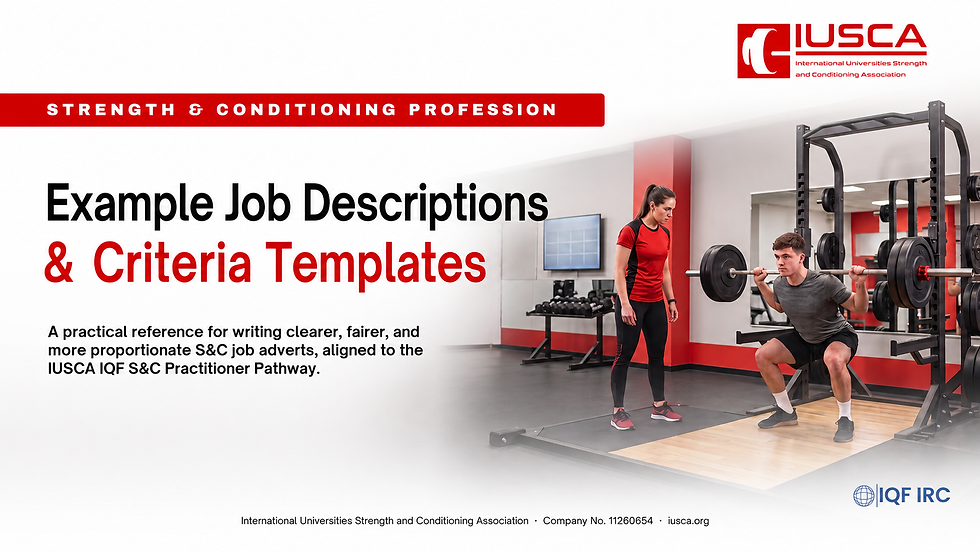
The International Universities Strength and Conditioning Association (IUSCA) has published a new practical handbook of Example S&C Job Descriptions & Criteria Templates, providing employers and other stakeholders with ready-to-use resources for recruiting across the strength and conditioning profession.
Following the publication of the IUSCA Employer Hiring Guide for Strength and Conditioning Roles, the new handbook translates its principles into practical templates that organisations can adapt directly when developing job descriptions, person specifications and recruitment criteria.
The resource covers common roles from supervised internships and placement positions through to autonomous practitioners, Heads of Strength and Conditioning, performance directors and consultants.
The aim is simple: to make it easier for employers to write clearer, fairer and more proportionate S&C job adverts, while improving consistency in how roles are described and aligned to the IUSCA International Qualification Framework (IQF) Strength and Conditioning Practitioner pathway.
From professional framework to practical implementation
The IQF provides a framework for understanding progression in professional S&C practice according to factors including reasoning, judgement, autonomy, responsibility, complexity and professional accountability.
For employers, however, applying those principles also requires practical decisions.
What should an Assistant Strength and Conditioning Coach actually be responsible for?
When should a degree be required?
What should distinguish a supervised placement from an autonomous practitioner role?
What criteria are appropriate for a Head of Strength and Conditioning?
When should advanced professional certification be essential rather than desirable?
The Example Job Descriptions & Criteria Templates have been developed to help stakeholders answer these questions when constructing real positions.
Rather than requiring every organisation to start from a blank page, employers can select the template closest to the role they need, adapt it to their own sport or organisation, and then refine the responsibilities and criteria to reflect the actual scope of practice.
The handbook makes clear that the suggested classifications are examples. Final IQF classification should always reflect the full scope of the role rather than the job title alone.
12 ready-to-use role templates
The handbook provides 12 detailed role templates spanning the S&C career pathway:
Strength & Conditioning Intern / Placement Coach, IQF Levels 2 to 4
Graduate Assistant Strength & Conditioning Coach, IQF Level 4
Assistant Strength & Conditioning Coach, IQF Level 4
Strength & Conditioning Practitioner / Coach, IQF Levels 4 to 6
Autonomous S&C Coach / Lead Sport S&C Coach, IQF Level 6
Senior Strength & Conditioning Coach / Practitioner, IQF Levels 6 to 7
Lead Strength & Conditioning Coach / Practitioner, IQF Level 7
Head of Strength & Conditioning, IQF Levels 7 to 8
Director of Performance / Athletic Development, IQF Level 8
School / Academy Athletic Development Coach, IQF Levels 4 to 6
Private Sector Strength & Conditioning Practitioner, IQF Levels 4 to 6
Strength & Conditioning Consultant, IQF Levels 6 to 8.
This means organisations can begin with a template that already reflects the approximate professional level of the position rather than trying to construct responsibilities and qualification requirements independently.
More than a suggested job title
Each template goes considerably further than providing a generic job description.
The resources include a suggested IQF classification, associated IUSCA IQF certification, recommended advert wording, potential role titles, role purpose, reporting structure, key responsibilities, essential criteria, desirable criteria, supervision or autonomy expectations, and criteria that employers should normally avoid.
For example, the Assistant Strength and Conditioning Coach template identifies the role as typically aligned to IQF Level 4 Practitioner, with independent decision-making within a defined scope and access to senior professional support. It then provides recommended certification wording alongside practical responsibilities and selection criteria.
For an autonomous practitioner, the expectations change. The Level 6 template describes full professional accountability for an assigned sport, team, cohort or programme and includes responsibility for programme design, monitoring, evaluation and applied decision-making.
At senior levels, the templates progressively recognise responsibility for practitioners, systems and organisational decision-making. A Head of Strength and Conditioning role, for example, may align with IQF Level 7 or Level 8 depending on whether its scope extends from advanced departmental leadership into strategic leadership, governance, standards and organisation-level responsibility.
Copy, adapt and use
A key purpose of the handbook is usability.
Employers are encouraged to take the relevant template and adapt it to their own:
organisation, sport, athlete population, country and employment context.
The organisation does not need to reproduce every responsibility or criterion exactly. Instead, the template provides a professionally aligned starting point.
When adapting the material, employers are encouraged to ensure that the role title reflects its genuine responsibility, salary is clearly stated, role scope is proportionate to remuneration, essential criteria are genuinely necessary, desirable criteria do not unnecessarily inflate expectations, and qualifications and certifications correspond to the autonomy and complexity involved.
This is particularly important because small changes to a role can change its appropriate professional classification.
A Strength and Conditioning Practitioner operating independently within a clearly defined programme may sit at IQF Level 4. A practitioner with full accountability for programme design, evaluation, athlete outcomes and complex applied decisions may instead require Level 6 capability.
The templates therefore provide a starting structure while retaining the flexibility required across different employment environments.
Helping prevent qualification and responsibility inflation
The resources also identify criteria that employers should normally avoid for each type of role.
For an internship or placement position, for example, the handbook advises against requiring a completed degree, advanced professional certification, several years of independent coaching experience or responsibility for athlete outcomes without appropriate supervision.
For autonomous roles, the opposite problem can occur. Employers should avoid assigning substantial independent responsibility while retaining an assistant-level title, status or salary. The Level 6 template specifically recognises autonomous programme design, professional accountability and independent decision-making as characteristics that should be reflected appropriately within the position.
The objective is to create better correspondence between what an employer asks someone to do and the qualifications, experience, certification, status and remuneration attached to that work.
Supporting different S&C employment contexts
The handbook also recognises that S&C practice takes place across substantially different environments.
Dedicated templates are therefore included for school and academy athletic development, private-sector S&C practice, and consultancy, alongside traditional professional and high-performance sport roles.
For youth-facing positions, for example, the templates explicitly address safeguarding, welfare, developmental appropriateness, communication with young people and collaboration with coaches, teachers, parents and other professionals.
The private-sector template similarly distinguishes between defined-scope Level 4 practice and Level 6 autonomous practice involving independent assessment, programming, monitoring and responsibility for client outcomes.
Consultancy can span an even wider range, from defined applied specialist support at Level 6 through to system development, organisational advice and standards work at Levels 7 and 8.
Consistent professional recognition
Each template also connects the role to the relevant IUSCA IQF certification or professional recognition.
Employers can use general wording such as:
Relevant IUSCA IQF certification or professional recognition, or equivalent recognised professional certification.
Where the professional level is clearer, the handbook provides ready-to-use wording for specific IQF levels, including the IUSCA IQF Level 2 Instructor, IUSCA IQF Level 4 Practitioner, IUSCA IQF Level 6 aISCP, IUSCA IQF Level 7 aISCP*m, and IUSCA IQF Level 8 mISCP.
This allows organisations to communicate the expected level of professional capability while continuing to recognise equivalent appropriate credentials.
A practical resource for the profession
The new templates are intended for clubs, academies, schools, national governing bodies, institutes of sport, professional teams, private facilities, performance departments, recruitment teams and other organisations employing S&C practitioners.
They can be used when:
creating a new position
reviewing an existing job description
establishing essential and desirable criteria
considering progression within an S&C department
benchmarking the scope of an existing role
aligning professional certification with responsibilities
preparing a vacancy for advertising through the IUSCA Job Board
Together with the Employer Hiring Guide, IQF Level Descriptors, role classification guidance and IUSCA Job Board, the templates provide another practical component of a more coherent professional infrastructure for strength and conditioning.
The intention is not to make every S&C job identical. Different organisations will continue to require different responsibilities, expertise and structures.
The aim is to give stakeholders a strong starting point from which those differences can be defined clearly and proportionately.
As with the wider Employer Hiring Guide, the governing principle remains:
Classification follows practice.
Employers should select and adapt the template that most closely reflects the position, with the ultimate classification determined by what the practitioner is expected to do, decide, lead and be accountable for in practice.
The IUSCA Example Job Descriptions & Criteria Templates handbook is available now, providing employers with ready-to-use templates across the S&C professional pathway.
View the IUSCA Job Board and employer resources: iusca.org/jobs


